
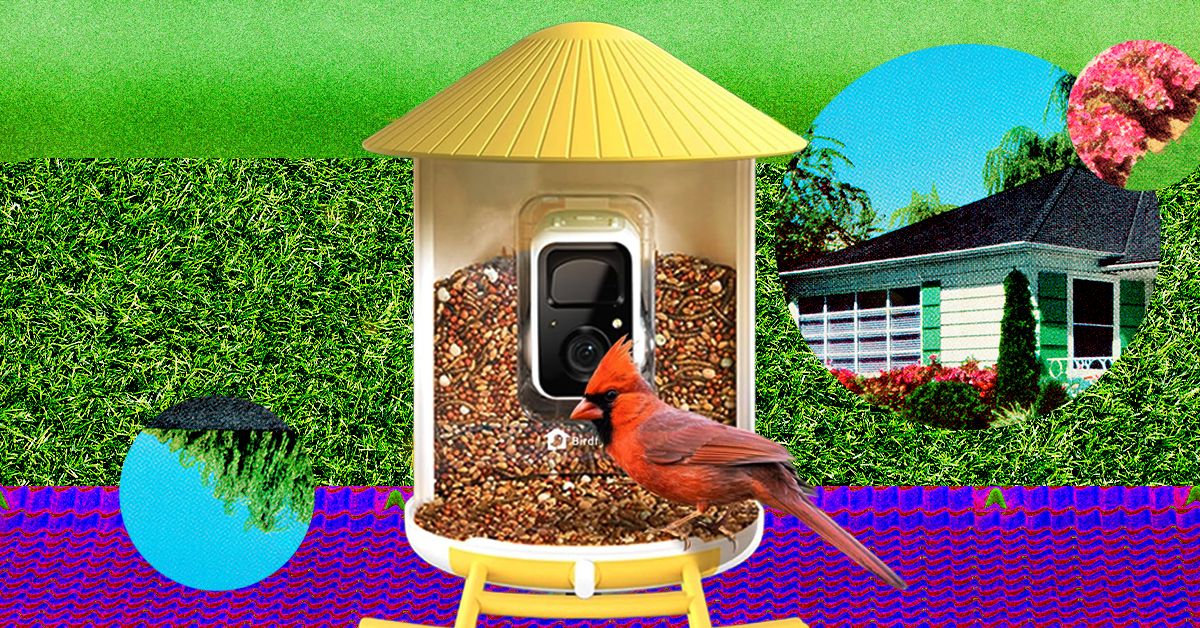
This feeder also comes with extra plastic flowers and a little brush for scrubbing them, and the app sends reminders when it’s time to clean. You’ll find fun, seasonal touches in the app, like the ability to send digital bird holiday cards with the photos your feeder captures, and a tool that superimposes hats, clothes, and various accessories on the birds, which is actually funnier than it sounds. However, as with the Birdbuddy seed feeders, the big downside is that the feeder’s sensor doesn’t always pick up every bird that visits, which can definitely be a bummer when you see something interesting out the window but it doesn’t show up in the app.
Best Smart Birdhouse

WIRED
- Two cameras show two action views
- Pole-mountable solar panel was reliable in my testing
- Different hole sizes can be mounted for different species
TIRED
- Wood requires upkeep
- Birds didn’t like mesh floor (it is removable)
After experiencing another round of connection issues with the Birdfy Polygon (below), I swapped it out for the newer Birdfy Nest Duo and have had no issues. The sleek, contemporary Duo is a fir box fitted with two cameras—one facing the hole and one tucked discreetly inside the feeder. That gives you a full-spectrum view of what’s going on. Both cameras have night vision (the internal one is infrared). Like the Polygon, the Duo sports a remote for rebooting and recharging the camera (though the separate solar panel, which can be pole-mounted, has kept the cameras reliably charged), as well as different-size holes for different species, each with its own chew-proof predator guard.
There’s a metal grate with drainage holes that you can slot into grooves in the lower third of the Nest to make the cavity larger or smaller. The interested birds of my yard seemed very put off by the grate, so I covered it with a layer of craft mat moss, which was a success—a chickadee promptly moved in and laid seven eggs, which all hatched. I detail the experience in a separate review. This was the first time I’ve had an occasion to use the Birdfly app’s ability to collect images from its nest boxes and string them together in a “story” that’s shareable online, but I didn’t find it especially useful or accurate. No matter, though, because the video captures have been a truly fascinating and educational experience, and I wish I could afford to buy the Duo for everyone I know.
So far, the Duo has been rained on a bunch and survived a couple of heat waves, but the wood finish and black paint are peeling and will need refinishing before going up for next season. (The feeder comes equipped with a thermometer and hygrometer to keep an eye on conditions. I recently had to zip-tie an umbrella to mine during a heat wave, which likely saved some fledglings’ lives, though the lightweight construction and black-painted side and top probably contributed to the box overheating.)
Best App Interface


Birdbuddy
Home Smart Bird Feeder with Camera
WIRED
- App is feature-filled and simple to navigate for beginners
- Feeder itself is extremely easy to assemble and use
TIRED
- Does not capture all bird visits
While Birdbuddy’s flagship Pro model is still available for sale on Birdbuddy’s website, there is an upgraded model only available on Amazon at the moment—the Birdbuddy Home (released earlier this year as the “Birdbuddy 2”). The feeder housing itself comes with multiple design upgrades, including a little half-sphere shaped camera that pops in and out with a magnet and an improved seed-filling hatch. I also has the ability to rotate the camera for a horizontal or vertical view, a feature borrowed from the CoolFly Aura. As with the Aura, I did not find this feature to be especially necessary or useful, but I did love how easy it was to install the camera, and was impressed by how well it stayed charged via the solar roof. (Although it did take a firmware update for it to function properly the first week I tried it.)
The Birdbuddy app still offers plenty of best-in-class features, like alerts for sick birds or cats, or for reminders when it’s time to clean. It also serves up bird facts and insights gathered over its use, such as what time certain species seem to prefer to visit. (Finches apparently like to visit my yard at 10 am daily.) There are unique seasonal additions like the ability to send holiday cards, or “dress up” visiting birds with hats, glasses, and sweaters. However, many of these features are now hidden behind a paywall for Birdbuddy Premium, which costs an additional $70 a year. You can still see “postcards” of the birds with many different views and video footage, and can still ID them via AI, but you will have to click a separate button.
However, my main problem with Birdbuddy has always been—and remains—the fact that the camera only captures a fraction of bird visits. In fact, while testing the Birdbuddy Home, I had it set up on a pole next to another brand’s feeder. I saw out the window that birds often visited one feeder and then the other, but on a particularly active day I noted that the other feeder had 127 image captures, while the Birdbuddy Home had … one.
