
For five years, Strategy Inc.’s position was ironclad: accumulate Bitcoin and never sell. That changed last week.
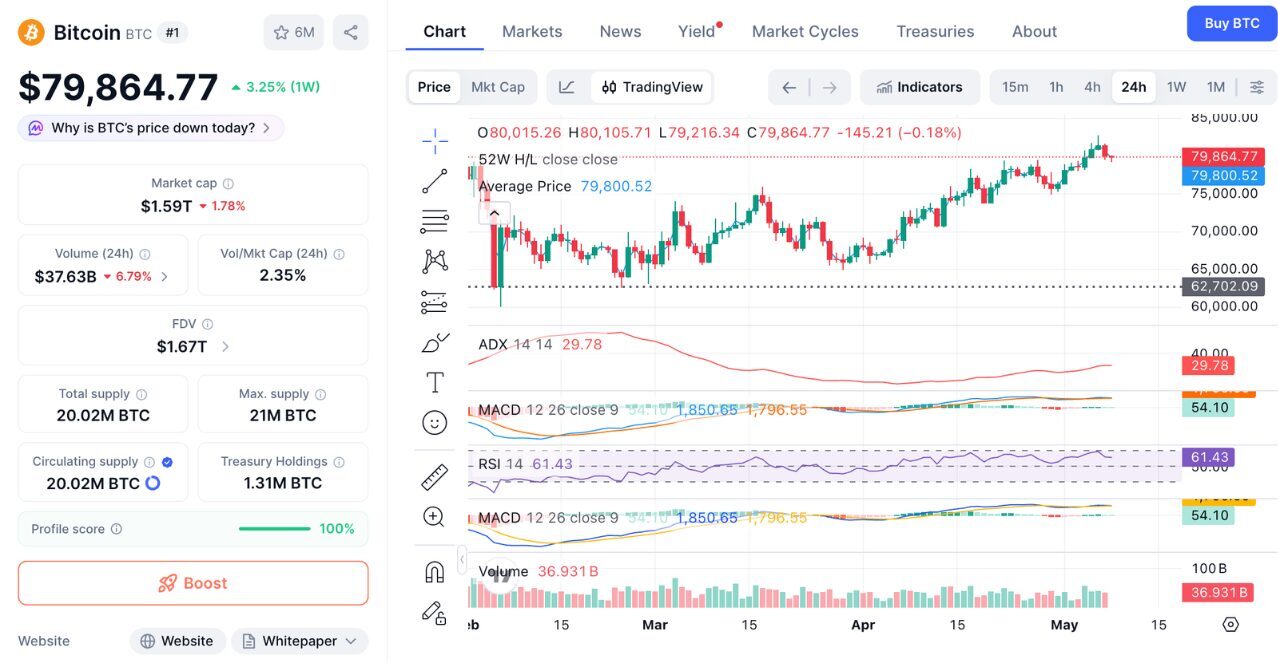
On May 5, 2026, during Strategy’s Q1 earnings call, CEO Phong Le and Chairman Michael Saylor signaled that the company could offload a portion of its 818,334 BTC — the largest corporate Bitcoin treasury in the world — when doing so is “advantageous to the company.” The announcement sent Strategy shares down roughly 4% and briefly nudged Bitcoin below $81,000. For retail investors who bought into Strategy’s famously unyielding conviction, the question is simple: what does this actually mean for the $80,000 price level, and should they be worried?
What Saylor actually said
The reversal is more nuanced than the headlines suggest. Speaking on the earnings call, Le said the company would consider selling Bitcoin “either to buy U.S. dollars or sell Bitcoin to buy debt if it’s accretive to Bitcoin per share.” Saylor himself was characteristically theatrical about it: “We’re like a Bitcoin development company,” he told investors. “We buy it cheap, we sell it dear.” He added that Strategy would “probably sell some Bitcoin to fund a dividend just to inoculate the market — just to send the message that we did it.”
The framing is deliberate. This is not capitulation. Saylor is describing a planned, transparent, sub-1% trim designed primarily to demonstrate that the company can convert Bitcoin to cash — a liquidity proof of concept aimed at short sellers who have long argued Strategy is structurally trapped in its position.

BTC 24h price chart (Source: CoinMarketCap)
The math behind the move
Strategy‘s balance sheet tells the real story. The company’s software operations generated $124.3 million in Q1 revenue — a figure dwarfed by roughly $1.5 billion in annual dividend obligations on its preferred stock. That gap has to be filled somehow, and with Bitcoin’s price declining during Q1, the company posted a $14.46 billion unrealised loss on digital assets and a net quarterly loss of $12.54 billion.
Even so, the scale asymmetry is striking. A 1% sale of Strategy’s holdings equals around 8,183 BTC — worth approximately $660 million at current prices. That alone could cover nearly half a year of dividend payments. The $1.5 billion annual obligation represents just 2.3% of total BTC holdings, meaning Strategy could theoretically fund dividends through measured sales for years without meaningfully depleting its treasury.

The math behind the move
Signal, not supply shock
Most analysts agree the real risk here is psychological, not mathematical. “Strategy selling Bitcoin matters much less as a supply event than as a signal of conviction,” Mathew Pinnock, COO of Altura, told Decrypt. Even a partial sale could trigger short-term panic, he warned, though ongoing ETF inflows and institutional demand would likely absorb the supply without lasting disruption.
Nic Puckrin, macro analyst and co-founder of Coin Bureau, echoed the point, noting that dividend-linked sales are fundamentally different from distress-driven liquidation. Sales “aren’t purely driven by market timing,” he said, which substantially reduces the likelihood of triggering a broader sentiment-driven sell-off.
The prediction market reaction was still telling. On Myriad, the probability of Strategy selling Bitcoin in 2026 jumped from 12% before the announcement to over 40% afterward — the highest level since the market launched.

Total Bitcoin Spot ETF Net Inflow (USD) (Source: Coinglass)
The corporate treasury model evolves
Andrew Webley, founder of the UK’s largest Bitcoin treasury company, Smarter Web Company, argued the announcement “is not a U-turn,” insisting that the framing matters as much as the substance. “The key point is that people need to separate ‘selling Bitcoin’ from ‘mismanaging a Bitcoin treasury,’” he said, stressing that the most important metric remains long-term Bitcoin yield per fully diluted share.
If Strategy can pay dividends without eroding its per-share BTC exposure, Webley suggested, it may actually strengthen the institutional case for Bitcoin-backed corporate finance rather than weaken it — demonstrating that the model is evolving from pure accumulation into a durable financial structure.
What retail should watch
For retail investors, the concern is less about whether Strategy sells a small tranche and more about what comes next. If sales become frequent and disconnected from the “Bitcoin yield” metric Saylor has championed, the company risks being reframed by markets as a leveraged financial vehicle tied to BTC volatility — rather than the conviction play that attracted so many shareholders in the first place.
The $80,000 level itself is unlikely to crack on the basis of Strategy’s selling alone. But the “never sell” promise was a psychological anchor for corporate Bitcoin adoption broadly. If the most prominent Bitcoin treasury company in the world is renegotiating that commitment, others may feel licensed to follow — and that shift in sentiment, more than any single sale, is what retail investors should be paying attention to.
Disclaimer NFTPlazas provides trusted news and insights on Web3. The views expressed on this site do not constitute investment advice. Before making any high-risk investments in cryptocurrency or digital assets, please conduct your own thorough research. All transfers and transactions are carried out at your own risk, and any resulting losses are solely your responsibility. NFTPlazas does not endorse the buying or selling of cryptocurrencies or digital assets and is not a licensed investment advisor. Please also note that NFTPlazas may participate in affiliate marketing programs.
