
Key Takeaways
- U.S. spot bitcoin ETFs saw $91.37 million in net outflows on June 8, while ether ETFs drew $82.37 million.
- The split, per Sosovalue data, points to rotation between the two largest crypto assets amid a selloff.
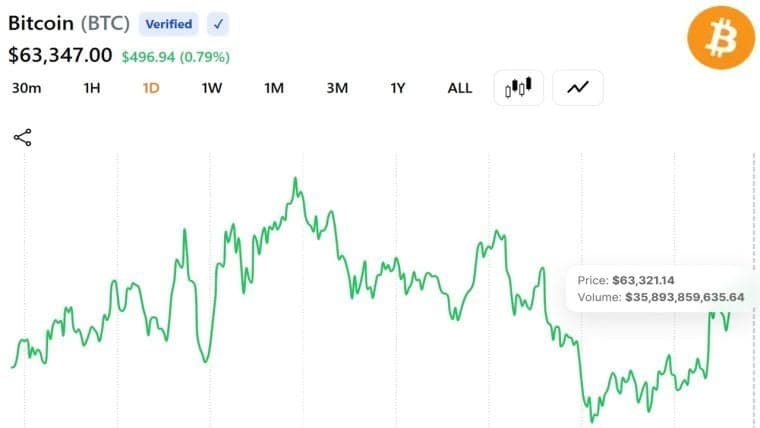
- Bitcoin ETFs have bled billions in a multi-week outflow streak as BTC fell to a 2026 low near $59,000 last week.
A Tale of Two ETF Markets
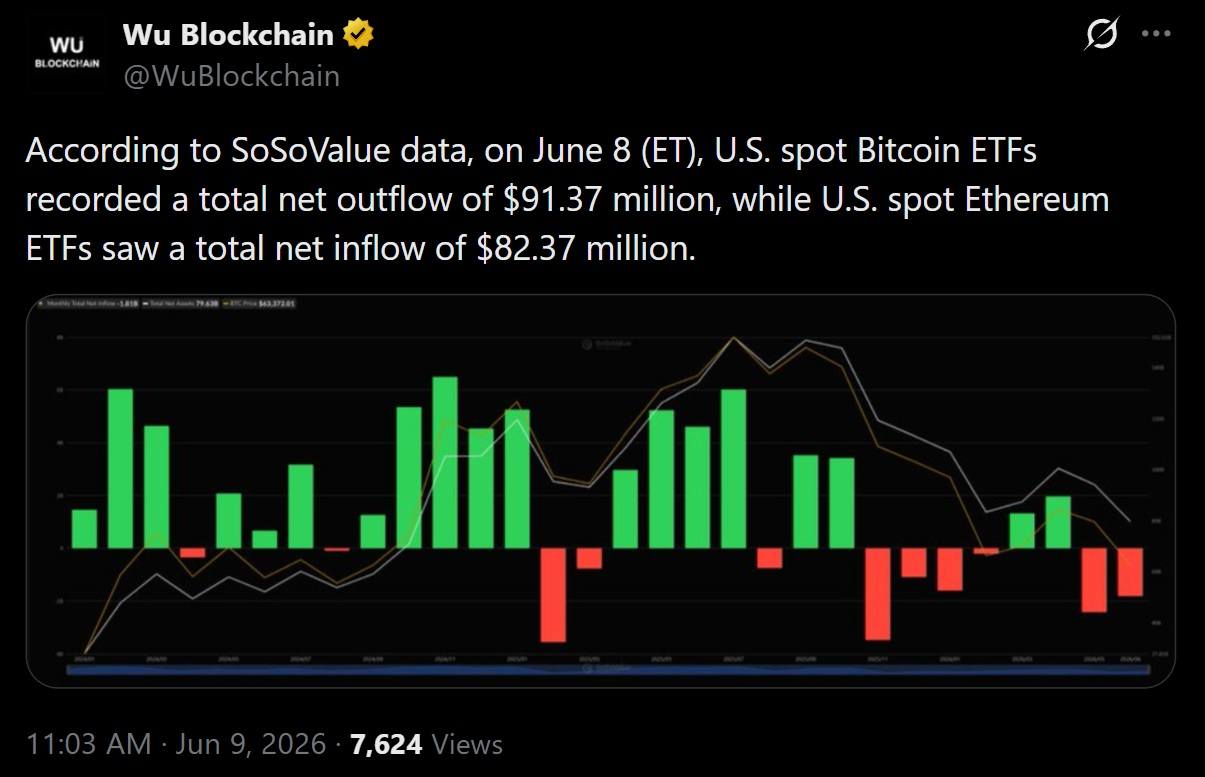
The split lands in the middle of one of the roughest stretches for crypto funds since they launched. On June 8 (ET), U.S. spot bitcoin exchange-traded funds (ETFs) logged a net outflow of $91.37 million, while U.S. spot ether ETFs recorded a net inflow of $82.37 million.
ETFs have become the clearest real-time gauge of institutional appetite for crypto, which is why a single day where the two largest funds move in opposite directions draws attention. Money leaving bitcoin while flowing into ether signals a classic rotation where investors seem to be trimming one position to add to another (rather than fleeing the asset class altogether).
The inflows into ether funds are more surprising, given how badly ethereum has performed this year, losing roughly 32% through the first 150 days of 2026 (and testing levels that have left many holders deep in the red). Yet that very weakness may be what is now attracting buyers who may be looking at ether as a discount buy rather than a warning sign.
Several threads could help explain the appetite. Ethereum’s staking yield, for instance, gives ether ETFs a potential income angle that bitcoin lacks, a feature issuers have been racing to incorporate. The network also remains the backbone of decentralized finance ( DeFi) and the settlement layer for a growing share of tokenized assets, giving long-term investors a fundamental thesis to lean on even when the price is falling.
When sentiment is this washed out, contrarian capital tends to look for the most oversold corner of the market, and in 2026, that has often been ether.
One Day Is Not a Trend
The absolute sums involved, i.e., under $100 million on each side, are modest by the standards of a multi-hundred-billion-dollar ETF complex, and single-session flows are notoriously noisy. A one-day divergence can vanish just as quickly as it appears, and broader 2026 data still shows both bitcoin and ether funds nursing heavy net outflows for the year. Some of the rotation narrative also reflects investors pushing further out the risk curve, with smaller solana and XRP funds quietly drawing their own inflows.
That said, what the activity does suggest is that institutional money is not simply abandoning crypto en masse, but instead it is being selective, rewarding relative value and yield/narrative strength rather than treating every token as a single trade.
If ether funds string together several sessions of inflows while bitcoin keeps leaking, the rotation thesis could gain real weight; otherwise, the divergence can be treated like noise.