
Bitcoin mining involves verifying transactions and introducing new Bitcoins into circulation. It refers to the process by which miners compete to solve cryptographic puzzles to add new blocks to the Bitcoin network.
In this article, we’ll explain the concept of Bitcoin mining, including its history, benefits, risks, and environmental impacts. We’ll also provide insights into how mining works and the costs involved.
What is Bitcoin Mining?
Bitcoin(BTC) is the pioneer digital currency that leverages blockchain technology for peer-to-peer transactions. Its underlying blockchain follows a proof-of-work (PoW) consensus algorithm, which harnesses the mining process to verify transactions and secure the network.
Bitcoin mining is a network-wide contest to crack a complex mathematical puzzle. The first miner to successfully generate an accurate cryptographic solution receives new Bitcoins and transaction fees as rewards.
This incentive mechanism will remain operational until the total Bitcoin supply of 21 million circulates in the crypto market. Once the last BTC is mined, the process will cease to exist. Thereafter, transaction fees will be the only revenue source for Bitcoin miners.
History of Bitcoin Mining
- Genesis block: Satoshi Nakamoto started cryptocurrency mining on January 3, 2009, by creating the first block that contained 50 Bitcoins.
- CPU mining: Early on, you could mine BTC using personal computers and central processing units (CPUs). It was a truly decentralized process because anybody could become a miner from the comfort of their home. However, as the number of miners increased, the mining difficulty rose. By July 2010, the complexity had surged by 4x.
- GPU mining: With the algorithm becoming harder to solve, miners started drifting toward graphics processing units (GPUs). Video cards performed complex calculations more efficiently. However, they consumed lots of computational power, rendering them ineffective for intense mining.
- FPGA mining: In 2011, Field Programmable Gate Arrays (FPGA) emerged as energy-efficient substitutes for GPUs. They could execute advanced calculations and were specially configured for BTC mining. Miners could tailor their hardware to Bitcoin’s mining algorithm. While their usage for cryptocurrency mining faded away in a short span, they paved the way for ASIC mining.
- Application Specific Integrated Circuit (ASIC): Since GPUs increased overall mining costs, miners gradually transitioned to ASIC machines equipped with specialized chips. Bitcoin mining has also become extremely complex and competitive over the years. Only mining pools with advanced ASIC computers that perform hundreds of trillions of computations every second can profitably mine BTC.
The Role of Mining in Bitcoin’s Supply
- Authenticates transactions: Whenever a user sends/receives Bitcoins, the transaction is broadcast to the network. Miners verify the transaction data and ascertain whether it is legitimate.
- Incentivizes miners: To encourage more users to participate in the mining process, it rewards winning miners with Bitcoins and transaction fees.
- Issues new coins: Mining creates new Bitcoins and introduces them into circulation in a controlled manner.
- Detects fraud: Mining eliminates double-spending. Since it records transactions in an immutable digital ledger, nobody can spend the same Bitcoin twice.
- Builds consensus: Bitcoin mining ensures all nodes agree to the blockchain’s current state and rules. It also helps maintain the security and integrity of the network.
- Fosters decentralization: Since mining is a resource-intensive process involving huge upfront costs, a single entity can’t take control of the network. It distributes control among numerous participants, nurturing decentralization.
How Does Bitcoin Mining Work?

Key Components
- Hash: It is a 64-character alphanumeric code generated when a block’s data is fed to the SHA-256 hash generator. This encryption technique creates a block hash instantly. Each block hash forms part of the next block’s header, chaining them together. Even a slight change in your input will generate a totally different hash, invalidating subsequent blocks. Thus, hash lies at the core of Bitcoin mining.
| Input | Output |
| Blockchain | 625da44e4eaf58d61cf048d168aa6f5e492dea166d8bb54ec06c30de07db57e1 |
| Blockchein | 687456bc39276f1c110dfd4d52c83ead86e7d9b64c74d4e173249675810a8b12 |
- Target hash: It is a number generated by the network. Miners need to generate a winning hash, meaning a number less than or equal to the target hash.
- Mining difficulty: It refers to the inherent complexity or the amount of work miners are required to do to generate the winning hash. The difficulty level is altered every 2016 blocks. It is determined by the efficiency of miners and the number of participants in the previous cycle.
Mining process
- Transaction validation: Miners pick unconfirmed transactions for verification from a mempool.
- New block creation: Miners verify and compile these transactions into a block. It can be appended to the blockchain only after it is approved. Typically, blocks record 1 and 4 MB of transaction data.
- Merkle root computation: Every transaction in the block is turned into a hash. Then, hash pairs are made and hashed together. This process continues till a single hash, called the Merkle Root, is created for all transactions.
- Deciphering proof-of-work puzzles: It involves finding a nonce value that produces a hash meeting the difficulty target set by the network. When a user starts mining, the nonce is set to zero. For each attempt made by the miner, the nonce value increases by one. Whenever a miner generates a hash and a nonce greater than the target hash, the attempt fails. Once the value reaches 4.5 billion, it can’t go higher. In that case, the system utilizes another counter, known as the extra nonce, from a different field.
- Block validation by network: Once a miner successfully generates a valid hash, the block must be verified by the network. The block is approved, provided the miner has found the correct solution and the transactions included in the block are legitimate. However, a block is not considered confirmed until five more blocks are added to the blockchain and it undergoes six validations.
- Adding a new block: After the network validates a block, it is added to the Bitcoin blockchain. The update is broadcast to the network, enabling every node to record the change in its individual ledger copy.
- Mining rewards: The successful miner is rewarded with new BTC tokens and transaction fees.
Benefits and Risks of Bitcoin Mining
Benefits
- Network security: Bitcoin mining prevents double-spending. Since blocks are cryptographically linked, even a small change in a single transaction changes the corresponding block’s hash. Consequently, the subsequent blocks will be rendered invalid. As redoing the proof-of-work for the invalidated blocks entails high costs, reversing or altering transactions is impossible.
- Decentralized transaction verification: Once a block is approved, it is broadcast to the entire network. Every node independently verifies the transactions and updates its individual copy of the ledger. This way, the network achieves consensus without relying on a central authority.
- Block rewards: If you’re able to generate a hash value less than or equal to the target hash, you’ll receive new Bitcoins and associated fees. These rewards are halved every 4 years in a halving event. As of January 2026, Bitcoin miners earn 3.125 BTC for mining a block. Since BTC is a high-value cryptocurrency, they can make phenomenal gains by selling it. Overall, block rewards incentivize more miners to participate in Bitcoin mining.
Risks
- Regulatory uncertainty: The mainstream adoption of cryptocurrencies, including Bitcoin, is relatively low globally. Some countries have banned them outright, while many have formulated stringent crypto laws. Thus, there is always a risk of governments prohibiting/restricting cryptocurrency mining, especially if you’re based in a non-crypto-native country.
- Price fluctuations: BTC price is highly volatile. As of mid-January 2026, Bitcoin is trading over $95,000. It has dropped by nearly 24.60% since its October 2025 peak of $126,000. Intense price volatilities make it harder to determine whether potential rewards will exceed the high mining costs incurred.
- Security concerns: The mining process is susceptible to 51% attacks, where a single entity/group gets majority control over the blockchain’s hashing power. Such attacks can lead to transaction manipulation or double-spending.
Sometimes, attackers engage in shadow mining. They build parallel networks and later seize the legitimate blockchain by displaying a longer chain. Such incidents invalidate the transactions recorded in the discarded blocks. However, due to the high costs of Bitcoin mining, the likelihood of these attacks occurring is very low.
Solo Mining vs Pool Mining: Which Is More Profitable?
| Solo Mining | Pool Mining |
| Individual miners use their own specialized hardware, equipment, and power supply units (PSUs) to solve complex cryptographic puzzles. | Miners pool their computing power and resources to solve complex cryptographic puzzles. |
| If successful, the solo miner earns 100% of the rewards, which comprises 3.125 BTC and associated transaction fees. | If successful, the reward is proportionately split among participants based on the computing power or hashrate each contributed. |
| It requires the individual miner to bear the entire mining expenses, including the purchase and installation costs of hardware and network infrastructure. | Each miner incurs only a portion of the total mining costs. |
| The payouts are high. | The payouts are small but consistent. |
| It is less profitable due to the high costs involved and the extremely low chances of successfully mining a block. | It is more profitable as each miner bears a portion of the costs, and farms/pools have a higher likelihood of mining blocks successfully. |
Common Bitcoin Mining Scams and How to Avoid Them?
- Bogus cryptocurrency exchanges: Many fake exchanges may contact you via phone, e-mail, or social media platforms. They may entice you with promo codes or fee discounts, convincing you to open an account. Once you deposit funds, they may disappear with your money.
- Phishing: Scammers often create fake websites mirroring legitimate exchanges/wallet sites, tricking innocent investors into revealing their private keys. They may even intercept your confidential data, including recovery phrases, by modifying URLs or launching DNS attacks.
- Fake wallets: Some fraudsters may transfer you a small amount from a fake wallet address that looks similar to your real recipient’s address. You may copy the wrong address and end up sending BTC to a scammer. Some hardware wallets also have inherent vulnerabilities that make it easier for malicious actors to steal your private keys.
- Cloud mining services: For many miners, setting up Bitcoin mining operations isn’t economically viable. Cloud mining platforms enable such miners to mine crypto without buying or maintaining the necessary equipment. However, some of these platforms can be scams in disguise.
- Malware: Hackers often install BTC mining malware in numerous computers and use them for mining. Once your device is hijacked for crypto mining, its computing power will be utilized completely. It may even overheat or burn up if not cooled using powerful fans. Therefore, you can’t even execute low-demand tasks. Moreover, the malware can spread from your device to other computers that connect to your network.
Best practices to avoid mining scams
- Never share your private keys, login credentials, and seed phrases with anybody.
- Exercise caution and apply due diligence before registering on any exchange or opting for a service.
- Rent hash power or mining rigs from reputable cloud-mining service providers.
- Avoid public Wi-Fi networks to connect to the internet, as they’re primary targets for online scams.
- Use virtual private networks (VPNs) when mining to keep your internet connectivity secure and private.
- Enable firewall protection and install antivirus software on the devices/machines you use for mining.
Environmental Impact of Bitcoin Mining
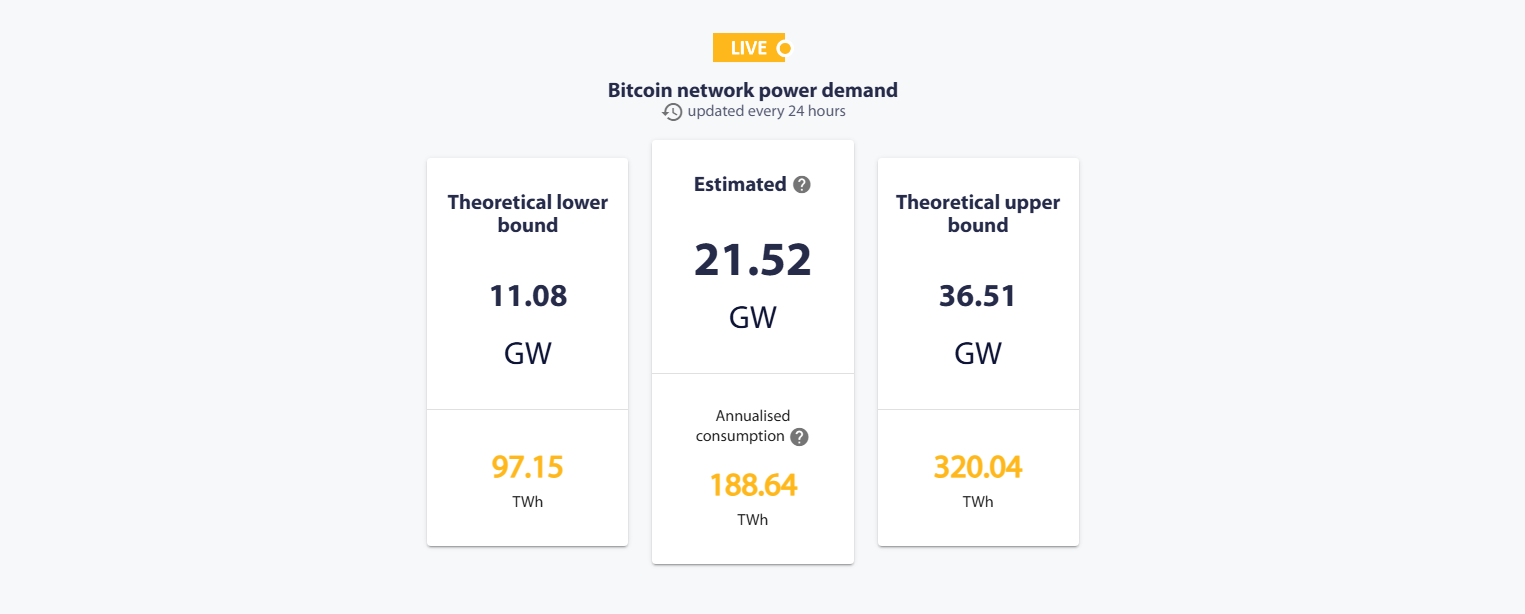
Bitcoin mining consumes a colossal amount of electricity and computational resources to power the specialized equipment. According to the Cambridge Bitcoin Electricity Consumption Index, the Bitcoin network’s annualized power consumption is 188.64 TWh. Its hardware efficiency ranges between 11 and 30.50 J/TH. These figures reflect the substantial carbon footprint that mining produces.
Moreover, mining hardware needs to be replaced every few years, resulting in considerable electronic waste. While the latest models of hardware equipment are more energy-efficient, the environmental concerns surrounding crypto mining are far from over.
Tax Implications of Bitcoin Mining
According to the Internal Revenue Service, USA, mined cryptocurrencies are treated as ordinary income. Hence, they’ll be taxed at your regular income tax rate. While reporting, you must disclose their fair market value at the time of receipt. However, if you make gains from selling/trading Bitcoins, you need to pay capital gains tax as well.
If you run a mining business, you can claim tax deductions on the expenses you incurred to establish/maintain the venture. Your taxable revenue is the value of the Bitcoins you receive. However, taxpayers who pursue mining as a hobby can’t deduct associated expenses.
Future Trends of Bitcoin Mining
- Eco-friendly mining: Many mining facilities like Gryphon, CleanSpark, TeraWulf, Iris Energy, and Bitfarms harness renewable or alternative energy sources to mine Bitcoin. These include solar, wind, hydroelectric, and nuclear energy. They’re also investing in AI infrastructure, high-performance computing, and green mining technologies to become carbon-neutral or carbon-negative.
- Tokenized carbon credits: Innovative solutions like KlimaDAO enable miners to buy tokenized carbon credits to offset their footprints. To ensure accountability, these credits are retired after purchase. Each credit represents one metric ton of CO2 decreased or eliminated from the environment.
- Hybrid consensus mechanisms: Researchers are testing hybrid systems, which combine the strengths of the PoW model and its energy-saving alternatives like proof-of-stake consensus. These include Green PoW, Proof of Elapsed Time (PoET), and Proof of Team Sprint (PoTS) mechanisms. These newer consensus algorithms may reduce the environmental impacts of Bitcoin mining in the future.
- Energy-efficient ASIC computers: The newer the ASIC model or cooling infrastructure, the more optimally it uses electricity. For example, the Antminer S23 Hydro model delivers a hashrate of 580 Th/s at 9.5 Joules per Terahash (J/TH). It is equipped with a hydro cooling system and utilizes less energy for every unit of hashing work.
Conclusion
If you’re interested in mining Bitcoin, you should weigh the high upfront costs and regulatory risks against potential returns. You also need to factor in Bitcoin’s intense price volatility. In general, it is more profitable to join mining pools rather than becoming a solo miner. Also, it is imperative to determine whether BTC mining is worthwhile based on your goals and resources at hand.
FAQs
Bitcoin mining helps maintain the integrity and security of the network. It involves creating new BTC tokens by solving complex cryptographic puzzles to validate and record Bitcoin transactions on the blockchain. The first user to find a solution adds a new block to the blockchain. The winning miner is rewarded with newly minted bitcoins and transaction fees.
Bitcoin mining requires you to invest in specialized hardware, cooling infrastructure, and PSUs, which can be quite high-priced. It also shoots up your electricity bills as it is an energy-intensive process. Moreover, Bitcoin prices fluctuate rapidly, making it difficult to calculate your potential returns. Furthermore, mining difficulty has increased manifold due to a large number of participants and Bitcoin’s popularity. Thus, joining mining pools or buying Bitcoin on crypto exchanges is worthwhile.
Bitcoin is mined using advanced ASIC computers that possess high mining power and can solve complex mathematical puzzles quickly. The first miner to generate a hash value less than or equal to the target hash wins the competition. Successful miners can add a new block and receive new Bitcoins and fees for their services.
It takes approximately 10 minutes to mine one Bitcoin block. Based on the number of miners competing and the computational power of the network, the difficulty level automatically changes.
Most countries, including the US, have legalized Bitcoin mining. However, the income/profits you generate from mining activities attract taxes. Additionally, governments are continually revising cryptocurrency regulations. Hence, before you start mining, ensure it is allowed in your jurisdiction and abide by the local and national crypto laws.
As of January 18, 2026, Bitcoin’s circulating supply is 19,977,290. Since Bitcoin’s total supply is capped at 21,000,000, around 1,022,710 BTC are left to be mined.
