
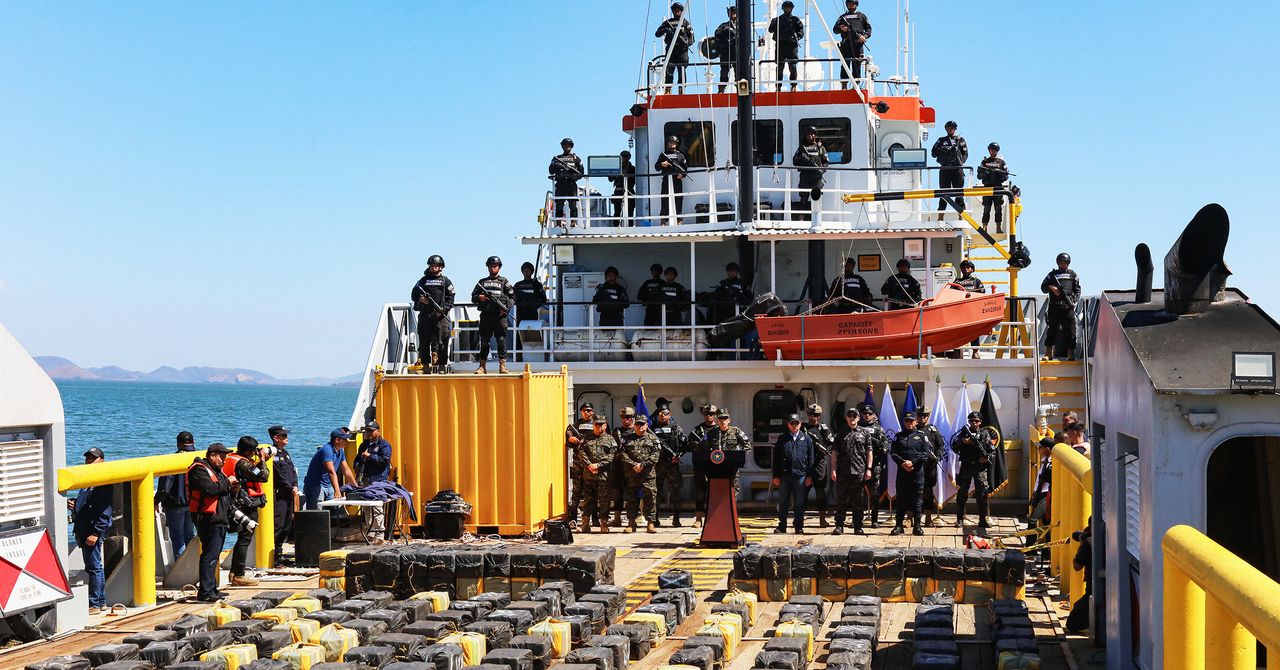
The Mexican Navy announced on Thursday that it had seized a semi-submersible vessel carrying nearly four tons of cocaine. The seizure of 179 packages of the drug is the latest result in an effort to curb maritime trafficking of illicit substances across the Pacific Ocean—an issue also being addressed by the United States through a series of deadly attacks in the Caribbean against vessels suspected of carrying drugs.
Omar García Harfuch, Mexico’s secretary of security, reported in a post on X that the interception of the vessel—known as a “narco-submarine”—took place in Mexican waters near Manzanillo, in the state of Colima. Three people have been arrested over suspected ties to the shipment.
The Mexican navy (Semar) said that the operation involved an ocean patrol vessel, two fixed-wing aircraft, two rotary-wing aircraft, and two interceptor boats. It also received support from US Northern Command and the Joint Interagency Task Force, which provided intelligence to locate the target at sea.
Harfuch emphasized that this action adds to other seizures made during the past week, which have resulted in the confiscation of approximately 10 tons of cocaine. According to the secretary, “this represents a direct and multimillion-dollar blow to the financial structures of organized crime, preventing millions of doses from reaching the streets and protecting the safety of Mexican families.”
Since at least last year, Semar has been monitoring a transnational network that uses the routes known as La Gorgona and El Desierto to transport narcotics and other illicit goods from Ecuador and Colombia. The route includes strategic points such as the Galápagos Islands and Clipperton Island before reaching Mexican shores, including Punta Tejupán in Michoacán. According to an investigation published by N+ Focus, the final destination of these shipments is the US market.
Criminal organizations use speedboats, submarines, and semi-submersibles, often homemade from fiberglass, to evade radar and maritime surveillance systems. Between 2023 and early 2025, monitoring and enforcement operations conducted by Semar resulted in the seizure of more than 111 tons of cocaine, 223 illegal maritime vessels, and the arrest of 476 suspected traffickers of Ecuadorian, Mexican, Colombian, and Central American nationalities.
The US government has pressured Mexico to intensify its fight against drug trafficking. Last year, the trafficking of synthetic drugs like fentanyl was used by the Trump administration as justification for imposing tariffs on Mexican imports.
Since then, Mexican president Claudia Sheinbaum has announced a tougher strategy against the cartels, which includes increased surveillance on maritime routes and borders, as well as the extradition of dozens of those convicted of drug trafficking offenses to the United States.
For his part, US president Donald Trump launched a campaign of direct confrontation against organized crime, even in international waters. According to The New York Times, Trump instructed the Pentagon to use military assets against Latin American cartels designated as terrorist organizations, representing the most aggressive strategy of his administration in this area.
Trump’s decree aimed to establish a legal basis for conducting both maritime and land military operations in foreign territory, marking a significant shift in US security policy by assigning to the military functions traditionally reserved for law enforcement agencies.
This policy led to the first US attack on a vessel that, according to the Trump administration, was transporting drugs from Venezuela to the United States. That incident occurred on September 2 in international waters of the southern Caribbean Sea and left 11 people dead, allegedly linked to the Tren de Aragua gang. Since then, dozens of similar attacks have been recorded in the Caribbean and the Pacific, with an estimated death toll of approximately 145 people.
This story originally appeared in WIRED en Español and has been translated from Spanish.
