
Key Takeaways
- America.gov provided useful official sources but missed some recent crypto legislation.
- Claude and ChatGPT offered more context on recent crypto regulatory developments.
- America.gov often hedged its answers and included “not advice” caveats.
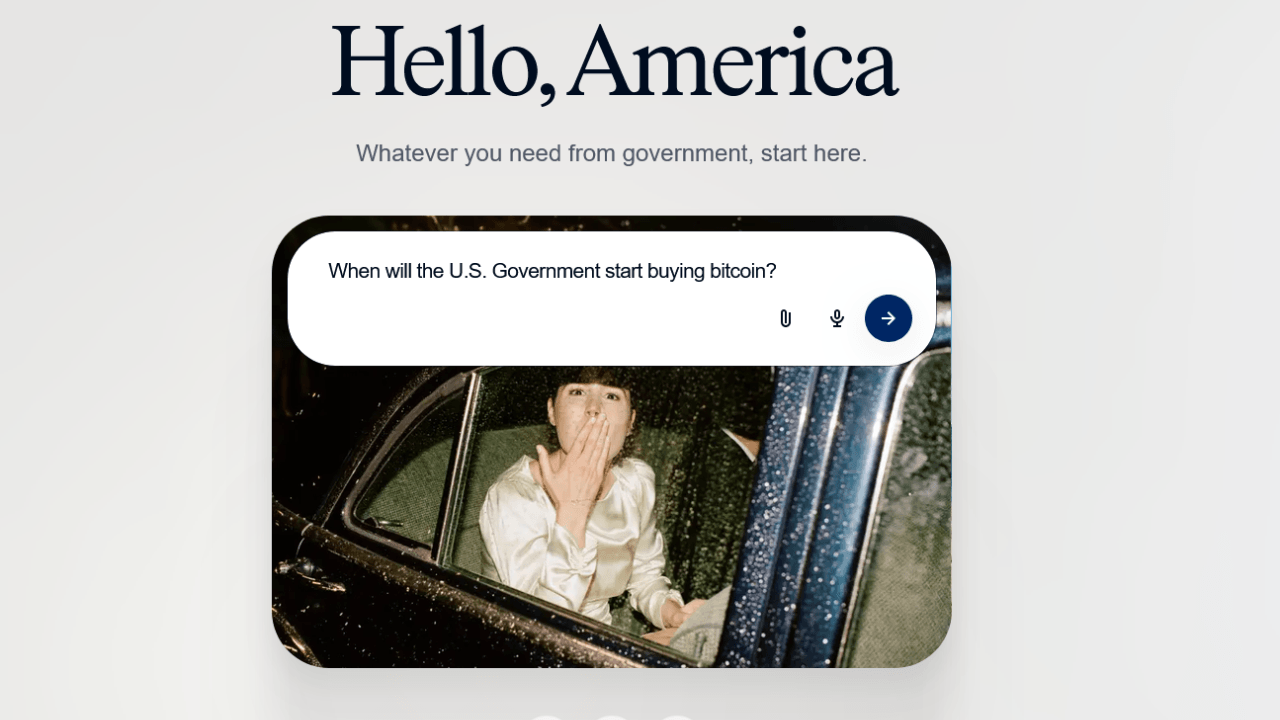
The new government website, designed to be a “unified digital front door” to the federal government, launched on Sept. 29. “You’ll save hours and hours, many hours, hundreds of hours perhaps, a year, depending on how much of that type of information you need,” President Donald Trump said during the launch event on Tuesday.
Gemini and Grok Behind America.gov
Google confirmed that the company behind the popular Gemini AI model is a technology partner on the project. U.S. Chief Design Officer Joe Gebbia added that Grok from Elon Musk’s SpaceXAI was also used in developing the platform.
Bitcoin.com News tested the platform, which, according to the government, pulls information and updates from around 29,000 government websites.
We asked 12 questions related to the federal government’s bitcoin and crypto policies, tax reporting, crypto asset usage, investor protection, and the Trump family’s crypto businesses. With Claude, Bitcoin.com News used the Sonnet 5.5 model at high effort, while ChatGPT was tested using the standard free version.
America.gov Misses What Is Happening in America
In general, America.gov was strong on tax forms, scam reporting, and safety warnings. However, unlike Claude and ChatGPT, it missed recent legislative developments relevant to the questions. It also presented outdated information about the U.S. Securities and Exchange Commission’s guidance on digital assets.
In either case, the platform, similarly to Claude, constantly hedged, adding a “not advice” line to its answers while also saying what it could not do in nine out of 12 questions. ChatGPT added none of these caveats.
Let’s look at those differences in more detail. For space and simplicity, Bitcoin.com News will provide America.gov’s answers while adding a comment on how Claude and ChatGPT performed in each case.
1. What is the status of the Strategic Bitcoin Reserve bill?
ChatGPT was the clearest here, while Claude was the most detailed. America.gov was out of date because it missed the fact that, on Sept. 16, a House committee advanced legislation that would codify the U.S. Strategic Bitcoin Reserve. Both other chatbots mentioned this vote. Meanwhile, the structure-loving ChatGPT summed it up most succinctly: “Strategic Bitcoin Reserve = already established policy. Strategic Bitcoin Reserve in federal statute = not yet law.”

2. How does the government protect my bitcoin and crypto investments?
All three were correct in essence: The protection is very limited. Claude provided the most current information, mentioning the GENIUS and CLARITY acts. Meanwhile, America.gov, while noting that crypto asset accounts are not backed by the government and listing various regulators’ positions, also warned that only criminals will ask for your private keys and seed phrases.

3. How to know whether my crypto is a security?
America.gov sends users to the SEC’s withdrawn guidance, while ChatGPT was the most detailed in naming crypto assets that are not securities. It also mentioned the SEC’s September FAQs as “staff guidance, not law or binding Commission rules.” Meanwhile, Claude said that “there’s no official list you can look up,” despite regulatory agencies mentioning specific tokens. “I cannot review your wallet or name a coin’s status,” America.gov wrote.

4. How do I report crypto on my federal tax return?
America.gov was the most useful of the bunch here, providing the most complete checklist. Meanwhile, only ChatGPT noted that paying a network fee in a crypto asset can itself be a small taxable disposal.

5. Is buying a coffee with bitcoin taxable?
Simple question, simple answer, and all three chatbots were correct, while the fight for the de minimis tax exemption is ongoing. Claude went a bit further into detail, adding that bitcoin payments via the Lightning Network are taxable too.

6. Can my crypto count toward a mortgage application?
America.gov was the most precise here on the current rule, while Claude mentioned how a person can use BTC or USDC as collateral without selling them. “You shouldn’t assume that $200,000 of BTC sitting in self-custody will be treated like $200,000 in a checking account,” ChatGPT concluded.

7. Are stablecoins FDIC-insured?
All three chatbots answered correctly—no, stablecoins are not Federal Deposit Insurance Corporation-insured. However, while America.gov didn’t mention the GENIUS Act elsewhere, where it was also relevant, it mentioned it in this answer. Meanwhile, ChatGPT’s answer seemed to be the least valuable in terms of detail.

8. What did the CLARITY Act change for crypto investors?
This is somewhat of a trick question, as the CLARITY Act failed an important vote in the Senate on Sept. 16. This recent detail was caught by both ChatGPT and Claude. However, in essence, America.gov wasn’t wrong either, writing that it can’t confirm from its sources that the act is law. America.gov described in the most detail what the bill would change if passed.

9. Can I hold bitcoin in my 401(k)?
All three confirmed that there is no federal right to hold bitcoin in a 401(k) and that this depends on your plan. Meanwhile, both Claude and ChatGPT offered more practical ways to do it, for example, via a bitcoin ETF. America.gov mentioned brokerage windows.

10. My crypto exchange went bankrupt. Is my money protected?
Here, America.gov was also correct, while Claude and ChatGPT provided more practical details, explaining that different situations might affect fund recovery differently.

11. How do I report a crypto scam, and can I get my money back?
All three provided similarly actionable steps, relevant links, and advice. For example, America.gov urged users to stop sending money and not tell the scammer that they had been reported. The government chatbot was also the best at providing relevant links where crypto crimes can be reported. Meanwhile, Claude and ChatGPT offered the most hope that the funds might sometimes be recovered.

12. What are the ethical and legal implications of Trump and his family co-owning World Liberty Financial?
America.gov refused to answer because it doesn’t “provide political commentary or legal advice.” Meanwhile, the other two chatbots offered more insights and details. “Whether it should be barred is a question for Congress and voters, and I’ll leave that judgment to you,” Claude concluded, while ChatGPT wrote that “potential conflict of interest” and “illegal conflict of interest” are not interchangeable conclusions in the case of a sitting U.S. president.

Another Chatbot You Need to Verify
So what do all these answers tell us about the government chatbot launched on Sept. 29?
For now, it appears to be most helpful for finding the official form, hotline, or rule when it comes to crypto assets. Meanwhile, if you need more context and the latest developments, other chatbots might serve you better, as America.gov is designed to use government sources only.
“AI can make mistakes, so check the sources included with each answer before making an important decision,” the platform’s own FAQ section warns.
