
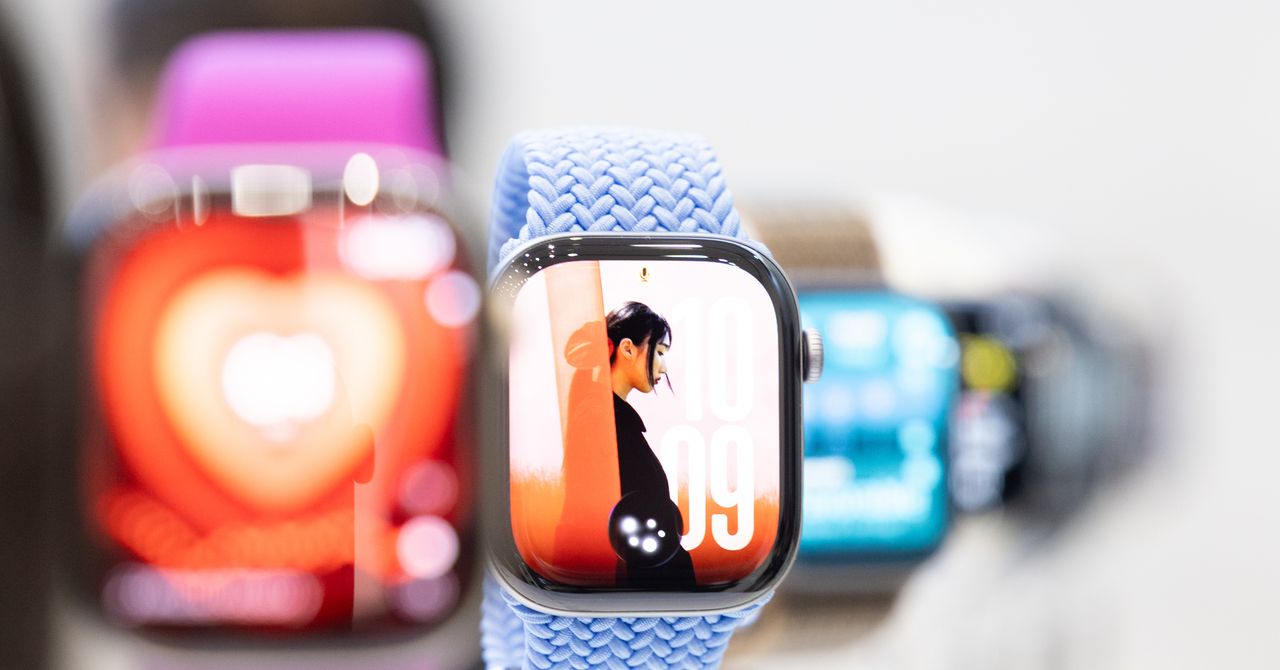
Apple is also making the watch easier to navigate with one hand, adding a single-tap gesture to Apple’s existing double-tap and wrist-flick controls. Tap your index finger and thumb together to select widgets in Smart Stack; double-tap lets you scroll through them. A wrist flick can return you to the watch face, silence timers, or dismiss notifications. These gestures are particularly handy (ha) when you’re multitasking or if you want to use your watch discreetly.
Better at Reading You
The new S11 chip brings the standard round of faster CPU and GPU performance, along with a more efficient Neural Engine. S11 also powers a remodeled pedometer to improve step counts and distance measurements, particularly during indoor walks and runs. Compared to Series 11, I didn’t notice much difference in numbers. I do, though, appreciate the new Steps complication, which puts my real-time step count on the watch face, so I can check my progress without opening the Activity app.
The bigger hardware upgrade is Apple’s new Health Sensing System. The Series 12 has 32 electrodes for improved skin contact during ECG readings, compared with two on the Series 11. The photodiodes have been rearranged in a ring configuration for improved optical sensing, and larger green LEDs have been added for more accurate heart rate readings.
The result, and one of the watch’s biggest selling points, is that it takes more frequent readings. The Series 12 measures heart rate every five seconds, even while you’re moving, whereas the Series 11 takes readings every five minutes when you’re relatively stationary. The Series 12 can also measure heart rate variability (HRV) as often as every five minutes, compared with every two hours on the Series 11, and it measures two variants: recovery HRV and overall HRV. For health-conscious people, the higher sampling frequency gives you a more continuous picture of how your body responds to stressors throughout the day instead of a handful of isolated snapshots. You can see those readings in the Heart Rate app or through the new live heart rate complications.
Readiness has at last arrived for anyone who has been anticipating a unified recovery score from Apple. The new Readiness app pulls together activity, sleep, and other health data to estimate how prepared you are for the day ahead. It takes seven days of sleep data before the score becomes available, which is standard for wearables to determine a baseline.
I like having the score as a quick shorthand instead of attempting to contextualize the individual metrics myself, but I stay skeptical of any recovery score that simplifies complicated physiological states using a proprietary algorithm. That said, Readiness is useful as a prompt to pay attention to your body, and I’m glad Apple finally has one.
Apple is also planning a redesigned Health app later this year, including a new Longevity tab and metrics such as Health Age, which compares your health data with that of your demographic. I haven’t been able to test those features yet, but I have a feeling my Health Age will either be oddly gratifying or immediately anxiety-inducing.
A Little Too Attentive
Audio Intelligence may be Apple’s most controversial addition. The suite brings four audio-focused features, including accelerated Shazam and Sound Recognition, the latter of which has been available on the iPhone since 2020. The more intriguing additions are Siri Recap and Live Rewind, which push the Apple Watch into murky waters by using its microphone to capture and process audio. I haven’t been able to test either feature yet; both are slated to arrive later this year.
Siri Recap is Apple’s answer to the AI notetaking boom. When enabled, it can transcribe conversations and generate summaries using Apple Intelligence. I can see the appeal for meetings and classes. During a briefing, I saw Siri Recap turn a PTA meeting into a detailed set of notes and reminders that seemed genuinely useful.
